Minggu, 04 November 2012

Mengenal Tanaman Mimba Dan Manfaatnya


Mengenal Tanaman mimba dan manfaatnya sangat berguna bagi pengetahuan tentang Pohon yang tingginya mencapai 20 meter dan diameter batang mencapai 100 cm, batangnya agak bengkok dan pendek, gubalnya berwarna kelabu, terasnya berwarna merah dan keras. Tajuk rapat, berbentuk oval dan besar. Selalu hijau dan tidak menggugurkan daun pada musim panas walaupun dengan panas ekstrim. Daunnya majemuk 7-17 pasang pertangkai, berbentuk lonjong dan bergigi. Daun sangat pahit dan bijinya mengeluarkan bau seperti bawang putih.

Nama  dan keberadaan Tanaman mimba

  • Spesies Azadirachta indica
  • Nama Inggris, bird`s-eye kalantas, nim, margosa, cornucopia, margosier, margosa tree
  • Nama Indonesia, Mimba, kayu bawang
  • Nama Lokal, Nimba (Jawa), membha, mempheuh (Madura), intaran (Bali), surian bawang, bawang kunyit (Kalimantan), nibwak (Irian Jaya)
  • Penyebaran, Nimba merupakan tanaman asli India dan Myanmar.
  • Habitat Tanaman ini dapat tumbuh baik dilahan kurang subur, berpasir dan berbatu, juga di daerah beriklim panas bahkan di daerah yang curah hujannya kurang dari 500 mm per tahun. Jika tumbuh di daerah curah hujan tinggi produksi daun nimba lebih banyak dan sangat sulit berbuah. Jika di tanam di daerah bercurah hujan rendah produksi biji nimba lebih banyak.
  • Perbanyakan Vegetatif dan generatif

Manfaat tanaman mimba

Tanaman ini dapat digunakan sebagai insektisida, bakterisida, fungisida, acarisida, nematisida dan virisida. Senyawa aktif yang dikandung terutama terdapat pada bijinya yaitu azadirachtin, meliantriol, salannin, dan nimbin.

Cara pemanfaatan tanaman ini sebagai biopestisida nabati  

  • Biji nimba dikupas / daun dimba ditumbuk lalu direndam dalam air dengan konsentrasi 20 - 25 gram/l;
  • Endapkan selama 24 jam kemudian disaring agar didapat larutan yang siap diaplikasikan;
  • Aplikasi dilakukan dengan cara penyemprotan, untuk pengendalian sedangkan untuk pengendalian nematoda dilakukan dengan cara menyiram di sekitar tanaman yang terserang
Mengenal tanaman mimba dan manfaatnya diperlukan agar kita bijai dan bukan hanya tahu tetapi juga mengerti tentang kekayaan alam tercinta ini agar kita peduli dan melestarikannya

Tumbuhan Pacar Cina yang bermanfaat dan berkhasiat

pacar cina, aglaia odorata
Tumbuhan pacar cina yang bemanfaat dan berkhasiat ini adalah tanaman yang mudah tumbuh di semak-semak, menghasilkan bunga kuning sebesar butir beras dengan bau harum dengan aroma wangi sangat kuat.  Aglaia odorata memiliki banyak khasiat untuk keperluan dunia kesehatan,  odorine dan odorinol diperoleh dari tanaman yang bersifat dingin guna meredam  aktivitas kanker chemopreventive.
Tanaman Perdu, tinggi 2 - 6 m, batang berkayu, bercabang banyak, tangkai berbintik-bintik kelenjar berwarna hitam. Daun majemuk menyirip ganjil yang tumbuh berseling, anak daun 3 - 5. Anak daun bertangkai pendek, bentuk bundar telur sungsang, panjang 3-6 cm, lebar 1 - 3,5 cm, ujung runcing, pangkal meruncing, tepi rata, permukaan licin mengilap terutama daun muda. Bunga dalam malai rapat, panjangnya.5-16 cm, warna kuning, dan harum. Buah buni, bulat lonjong, warnanya merah, panjang 6 - 7 mm, dengan ruang 1-3, biji 1-3.

Ciri tumbuhan pacar cina yang bermanfaat dan berkhasiat

    1. Spesies  Aglaia odorata
    2. Nama Inggris Culan
    3. Nama Indonesia Daun pacar cina
    4. Nama Lokal Culan (Sunda), Pacar Culam (Jawa), Pacar cina, culan (Sumatra)
    5. Distribusi/Penyebaran tanaman ini meliputi India, Cina bagian selatan, Asia Tenggara, Australia bagian utara dan kepulauan di Samudra Pasifik. Di Indonesia tumbuhan dapat ditemui tumbuh di pulau Sumatera, Kalimantan, Jawa, Philipina, Sulawesi, Bali dan Flores.
    6. Habitat Pacar cina sering ditanam di kebun dan pekarangan sebagai tanaman hias, atau tumbuh liar di ladang-ladang yang cukup mendapat sinar matahari.
    7. Perbanyakan melalui cangkok.

    Kegunaan tumbuhan pacar cina 

    Senyawa aktif utama yang bersifat insektisida dan dapat dijadikan sebagai bahan pembuatan biopestisida ini termasuk dalam golongan benzofuran. pada daun Aglaria odorata selain rokaglamida juga ditemukan, dan tiga senyawa turunan yaitu desmetilrokaglamida, metil rokaglat dan rokaglaol. Aktivitas ekstra bagian tanaman pacar cina selain bersifat insektisida dapat juga bersifat antifidan atau penghambat perkembangan

    Sabtu, 03 November 2012

    Tanaman obat tradisional dlingo sebagai biopestisida

    Tanaman obat Acorus Calamus atau Dlingo/ Sweet roof
    Acorus Calamus - Dlingo
    Tanaman obat tradisional dlingo/Acorus calamus sebagai tanaman biopestisida Tanaman Herba,jenis tanaman yang hidup dengan umur tahunan, tinggi + 75 cm. Basah, pendek, membentuk rimpang, putih kotor. batang Tunggal, bentuk lanset, ujung runcing, tepi rata, pangkal memeluk batang, panjang ± 60 cm, lebar ± 5 cm, pertulangan sejajar, hijau. Majemuk, bentuk bongkol, ujung meruncing, panjang 20-25 cm, di ketiak daun, tangkai sari panjang ± 2,75 mm, kepala sari panjang ± 2,75 mm, kepala sari panjang 0,5 mm, putik 1-1,5 m, kepala putik meruncing, panjang ± 0,5 mahkota bulat panjang, panjang 1-1,5 mm, puith. Serarjut. coklat.
    • Spesies Acorus calamus
    • Nama Inggris Sweet flag, sweet root, calamus
    • Nama Indonesia Daringo, dlingo
    • Nama Lokal Daringo (Sundanese), dringo (Javanese), jerango (Sumatra)
    • Penyebaran di Indonesia didapati tumbuh liar, Habitat   Tumbuh di tempat yang lembab seperti di tepi danau dan sungai.
    • Perbanyakan atau perkembang biakan, dapat berkembang biak dengan rimpang, dengan mengambil ujung rimpang, daunnya dipangkas, akar yang halus dibuang kemudian ditanam.

    Manfaat tumbuhan Tanaman obat dlingo

    Rimpang Acorus calamus berkhasiat sebagai obat penenang, lambung dan obat limpa, di samping itu merupakan bahan baku kosmetika. Rimpang dan daun acorus calamus mengandung saponin flavonoida, di samping rimpangnya mengandung minyak atsiri yang berguna sebagai pengusir serangga.

    Cara pemanfaatan tanaman obat dlingo sebagai biopestisida:

    • Menumbuk daun dan atau umbi lalu direndam dalam air dengan konsentrasi 25 - 50 gram/l selama 24 jam.
    • Larutan hasil perendaman ini disaring agar didapat larutan yang siap diaplikasikan.
    • Aplikasi dilakukan dengan cara penyemprotan.

          Tanaman dapat berfungsi sebagai tanaman obat untuk manusia, juga dapat digunakan sebagai pestisida alam yang tidak kalah tangguhnya dengan pestisida kimia, demikian informasi tanaman obat tradisional dlingo sebagai biopestisida

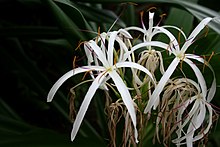
    Tanaman bakung bunga putih - Crinum Asiaticum

    Spesies

    Nama Inggris
    Crinum lily, poison bulb
    Nama Indonesia
    Bakung
    Nama Lokal
    ·         Bakung (general),
    ·         Bakung, Bakong (Batak)
    ·         Semur (Bangka)
    ·         Bakung(Minangkabau)
    ·         Bakung (Melayu)
    ·         Bakung (Sunda)
    ·         Bakung (Jawa Tengah),
    ·         Kajang (Palembang)
    ·         Bakong (Madura)
    ·         Bakung bug (Makasar)
    ·         Dausa (Ambon)
    ·         Pete (Halmahera)
    ·         Fete-fete (Ternate)
    Herba, tahunan, tinggi ± 1,3 m. Batang semu, diameter ± 10 cm, tegak, lunak, putih kehijauan. Daun tunggal, lanset, panjang 32-120 cm, Iebar3-10 cm, tebal, bertepi rata, ujung meruncing, pangkal tumpul, bila dipotong melintang nampak lubang-lubang, hijau. Bunga majemuk, bentuk payung, tangkai pipih, tebal, panjang 35-120 cm, pangkal mankota berlekatan, bentuk corong, putih, pulik panjang ± 16 cm, ungu, benang sari melengkung keluar, tangkai sari panjang 5-10 cm, kepala sari warna jingga, bakal buah berbentuk elips, panjang ± 1,5 cm, putih keunguan. Buah kotak, bulat telur, tiap kotak terdapat 1 biji. Biji keras, bentuk ginjal, panjang ± 5 cm hitam. Akar serabut, silindris, putih.
    Distribusi/Penyebaran
    Sumatera, Jawa, Sulawesi, Maluku
    Habitat
    Pantai berpasir dan asosiasi mangrove
    Perbanyakan
    Dapat diperbanyak dengan biji,stek
    Manfaat tumbuhan
    Tanaman ini telah lama digunakan sebagai bahan obat tardisional depresan sistem syarat pusat.Tanaman ini dapat digunakan sebagai pengganti pestisida yang berfungsi sebagai bakterisida, dan virisida.Senyawa dari tanaman ini mengandung alkaloid yang terdiri dari likorin, hemantimin, krinin dan krianamin.Tanaman ini bermanfaat untuk menekan /menghambat pertumbuhan Fusarium oxyporum.
    Cara pemanfaatan tanaman ini sebagai pestisida nabati dapat dilakukan dengan :

    1. Menumbuk daun dan atau umbi lalu direndam dalam air dengan konsentrasi 25 - 50 gram/l selama 24 jam.
    2. Larutan hasil perendaman ini disaring agar didapat larutan yang siap diaplikasikan.
    3. Aplikasi dilakukan dengan cara penyemprotan.
    Ini adalah hanya sebagian dari informasi mengenai tanaman bakung bunga putih atau crinum asiaticum, dapatkan informasi tentang tanaman ini dalam tulisan yang lain


    Shoots Yellow bamboo is Traditional Medicine on Liver disease

    Shoots Yellow bamboo is Traditional Medicine on Liver disease
    Disease that occurs in the liver / liver can be caused by several things. The cause of the liver disease / liver major is a virus, rather than one of the five hepatitis viruses (A, B, C, D or E), can also occur due to other viral infections such as infectious mononukleosisi, cytomegalovirus infection and yellow fever. While liver disease / liver that occur due to non-viral due to alcohol, drugs and chemicals or synthetic liver damage (hepatotoxic).

    Bamboo
    Yellow bamboo (Bambusa vulgaris) is one kind of bamboo plants that have unique privileges of the other types of bamboo. When observed buluhnya yellow but with a little clump. Well because it was unique and different from other types of bamboo yellow bamboo better known as an ornamental plant.
    Another feature is the yellow bamboo shoots a sweet taste and can be used as a vegetable. also efficacious as a cure liver disease / liver.

    What Ingredients and Efficacy Yellow Bamboo shoots?

    By our ancestors, yellow bamboo shoots are used as a cure jaundice / jaundice (Hepatitis A). Its use has traditionally been handed down for generations. As is known jaundice associated with liver function irregularities, so often referred to as "liver disease" or "liver disease".

    Yellow bamboo shoots containing the hydroxy bemsaldehid, which is a phenol that is similar to some of the cluster of silymarin and curcumin. Both cluster is efficacious as an anti-poison heart. Silymarin compounds have long been marketed as a cure liver or liver medication or hurt by a trademark.

    According to a German study, extracts of bamboo shoots can repair damaged liver cells animal experiments, which previously deliberately tampered with liver toxicity. The use of bamboo shoots traditionally, done like drinking herbal 'boiling' (herb stew). The recipes are used, one part (maybe one cup) sliced ​​bamboo shoots dried yellow mixed with 10 parts of water. Mixture is boiled until boiling. Fifteen minutes after boiling, the heater is turned off. In a state still hot, boiled filtered and cooled. Having a cold can lagsung drunk. Every drink is a third dose glass; may be taken up to three times a day. Because it was a bit sour, can add sugar. If boiling water is up, the pulp of bamboo shoots can be used again (boiled again) up to three times. (Wahyono, Faculty of Pharmaceutical Biology UGM - Poster)

    Meet our nutrition and good rest so that the virus does not infect and invade the liver or liver. With a strong immune system, the body will be able to handle this dangerous viral hepatitis, now we are know if Bamboo Shoots Yellow bamboo is Traditional Medicine on Liver disease

    Kamis, 01 November 2012

    humus daun bambu untuk kompos

    Humus daun bambu untuk kompos dapat digunakan sebagai material untuk pembuatan media penanaman tanaman hias, banyak digunakan karena porous baik, juga karena sangat bagus untuk pertumbuhan tanaman hias, humus bambu juga netral, tidak akan mengeras atau sebaliknya walaupun digunakan sebagai media tanam dalam waktu yang lama

    Jenis tanaman hias yang banyak menggunakan media tanam humus bambu adalah jenis tanaman Agloanema, Anthorium bunga jug bisa menggunakan ini, tetapi lepas dari jenis tanaman hias yang dapat tumbuh bagus dengan media tanam humus daun bambu, disin perlu di informasikan bahwa daun bambu sangat bagus sebagai media tanam untuk tanaman hias
    humus daun bambu untuk kompos

    Proses humus daun bambu untuk kompos

    Kompos adalah campuran bahan organic dan pupuk kandang, yang diproses pembusukan, dapat dipercepat proses pembusukan tersebut dengan fermentasi yaitu pencampuran bahan cairan yang berisi bakteri yang menguntungkan untuk mempercepat proses pembusukan bahan organic tersebut. kompos yang dihasilkan dari percampuran daun bambu yang dicampur dengan pupuk kandang adalah kompos daun bambu, yang dapat berfungsi sebagai pupuk organic, lama waktu pembuatan kompos adalah 1 bulan, sedang dengan fermentasi hanya diperlukan waktu 7 hari, tetapi ada syarat untuk dapat berhasil membuat kompos secara fermentasi, yaitu
      1. Suhu kisaran 50 derejad celcius
      2. Tidak terkena sinar matahari langsung
      3. Tidak terkena air hujan langsung
      Selamat mencoba bercocok tanam dengan bahan yang ada disekitar kita, terutama humus daun bambu untuk kompos

      compost as a planting medium

      Compost as a planting medium like as Rice straw or other agricultural waste soft, it easily composted. Only with stacked just, lapse of three months later the material was going to be composted. But so will compost quickly solidifies and sticky. If compost is used to fertilize rice fields or fields, the compaction and sintering are not an issue. The fields are lush, the mud is composed of organic materials that have been destroyed and become sticky. Different if the compost will be used as a planting medium pot. Media planting pots require a high level of porousitas. The more that will be planted ornamental plants like ferns.

      planting media
      That is why maidenhair ferns and ferns will only grow better if planted with bamboo planting medium humus. Because despite being destroyed, bamboo humus remains neutral (pH 6.5 - 7). The destruction of a bamboo humus also still form a porous mass, does not compact and not sticky. Until the water is poured into the media will continue late into the bottom. Bamboo is called humus, leaf litter remains, sheath and bamboo twigs scattered under the clumps. Humus bamboo is an excellent medium for growing specific maidenhair ferns and other ferns in pots. Up to now, there is no other more appropriate medium for growing families ferns besides bamboo humus.

      Compositions for planting medium pot, it should be possible. If we only use a soft organic materials, such as straw, then a period of less than one year, the media would already be compressed. If the pot is placed in the crops, it does not matter. Because when the media has been compressed, will be the replacement plant. Similarly, if the plant needs repotting dipotkan it (replacement pot) once a year. Along with penggantiap pot, also conducted replacement planting medium. If it is planted palm that is not necessarily done repotting every two years, the media compositions pot should really be taken into account.

      First of all these media require easy compost materials such as straw destroyed. Second, the media also requires that water-binding agents such as cork softwood bark, coco dush and clay. But the media also requires organic material that is not easily broken. For example sawdust (or poo shavings) from hard wood. In Australia, for example, used sawdust from oak and eucaliptus very hard. Here, it can be used sawdust teak, camphor, Rasamala etc.. And lastly, composting requires fine sand that condition remains porous. Comparison of each of these media depends on the type of plants.

      If planted crops that require a lot of water, then the components of clay and powdered cork enlarged. If these plants require a high level of porousitas (not like water) then the composition of sand and sawdust are propagated severity. That requires a lot of water is a plant with broad leaves and soft. For example, the types of impatiens, begonias, etc.. While that does not like a lot of water is a type of ferns and cactus and succulent especially. Media for cactus and succulent, even enough to be a 75% fine sand and humus (compost smooth) 25%. Cactus and succulent really do not like the water until watering is only done once a week enough. Cactus and succulent pots should be placed in the green house, to avoid the rain.

      bamboo humus
      Compost as a planting medium
      The ornamental plant breeder Selecta (East Java), Bandungan (Java), Lembang and Cibodas (Jabar), using a compost consisting of normal soil mixed with chaff former broiller chicken litter. The comparison, 1/3 soil mixed with 2/3 chaff. With this media, media porousitas can stay awake. Because chaff will be destroyed after about two years of mixed tahah. Seed plants for a period of less than one year must have been terpasarkan. In addition because of porousitas, media usage husks also meant that crops sown in bamboo baskets, plastic bag, or most of them in a clear plastic bag, it becomes lighter when transported over long distances.

      For the purpose of reducing the weight of breeder seed is the fruit crops in Thailand using cork media moss or coconut coir (coco dush). The meaning is the root kadaca moss (bird's nest fern). Using moss and coco dush media is done, since the lifting of seedlings of the land to be transferred to polybags. With moss and coco media dush, the weight of the seed crop could be reduced by about 2/3nya. Till when using a soil medium weights seeds contained in a 2 ton pick up, for example, then the media moss and coco dush weight will shrink to 0.66 tons. While the volume remains the same. Thus the transport of seeds, usually with stacked (laid) crisscrossed sleep. Until the vehicle capacity can be quite large.

      Making compost in bulk, made by mixing various ingredients in a shaded space. Usually dirt ruminants (cattle / sheep), swine and poultry mixed with sawdust. Mixing is done by heavy equipment in the ward that the width can be as big a football field. Along with pangadukan, adding water, starter bacteria and also in the form of oxygen. In this way, the composting process can be shortened just a few days than it should be for about three months. For use in regular land, the finished compost can be sown directly. But for use as a medium pot / polybag, compost is still to be mixed with a variety of materials.

      Nursery-nursery, usually prepared materials such as compost for growing media, fertilizer guano (bat droppings), fine sand, hardwood sawdust, rice husks, cork (of bark or coco dush), limestone and clay. The material was to be mixed according to plant needs. Ornamental plants such as Aglaonema, anthurium and begonias for example, requires more media composition of organic materials. Up to this part of the compost plants at most. For example, up to 60%. Of which 40% consists of cork, hardwood sawdust / husks, clay and sand. For such plants require a fixed porous media and contains a lot of water.

      Unlike the cacti and succulent plants. Including these plants are Adenium and Euphorbia that lately in vogue society. These plants actually need more sand as the media cropping. Until the composition is reversed: 60% sand and 40% compost and hardwood sawdust / bran. Clay and cork are not required. For the second function is the binding medium of water. Though cactus and succulent it does not want the water. Ornamental plants such as ferns, require a porous media, still wet but does not contain a lot of water. If there is no humus bamboo, media composition for ferns consists of 60% hardwood sawdust / bran and 40% compost.

      Straw, both rice and wheat straw, compost will yield homogeneous soft and easily compressible / solid. Sorghum stalks and relatively heterogeneous, ie, composed of fiber and cork on the inside as well as the hard bark on the outside. However, maize and sorghum stalk still could not last too long as the planting medium pot. The most ideal as compost are twigs and leaves hard wood. In Jakarta, the logging / lumber angsana just thrown away in landfills (Landfill) Capital trash. In fact, this waste can be shredded and composted with chooper. Compost from the following branches angsana leaves is quite good, because the leaves will rapidly disintegrate, while the woody branches will be able to last long enough.

      Skin and corn cob is also a pretty good compost material. Skin corn contains a lot of strong cellulose, while cob contains many hardwoods that will take a long time to disintegrate. If the skin and the cob is combined with corn stalks and leaves, would be an ideal compost material. Similarly, stems and skins of peanuts. In our country stems and leaves of peanut forage is highly qualified. While the skin is discarded or burned more futile. In fact, compost peanut shells are pretty good, which is to substitute cork materials and hard parts.

      The combination is also ideal husk and rice straw. Rice straw will quickly solidify. While the chaff requires long time to disintegrate. If the two materials are mixed, it will be a planting medium pot is ideal. Excess planting medium that consists of only organic materials are porous and light weight. If pots or polybags will be pulled up and carried long distances, then the media should ideally be planted without the sand and clay to keep it light. If the pot will be placed permanently in one place, then the addition of sand and clay becomes problematic


      Label